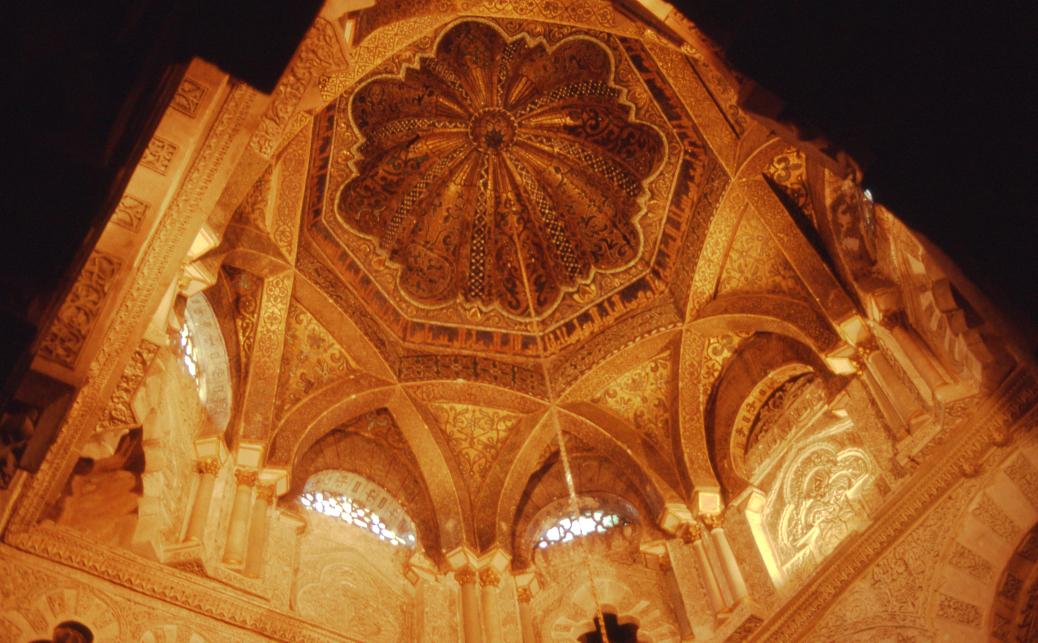
Córdoba's main attraction is the mezquita, the Moorish mosque that was turned into a cathedral by the Catholic conquerors. I slept in a little because it was Sunday. I couldn't do that for too long because the bedclothes smelt a bit musty. The dueño had looked jaunty the evening before with his cigarette holder and jacket, ready to go out with his esposa. In the morning he looked less dignified. I had surprised him leaving the shared shower in the courtyard, causing him to exclaim ¡Jesucristo! I think he may even have been showering with his wife, perhaps to save water.
A gypsy was playing an ocarina in the grounds of the mezquita. It was dim inside. The most eye catching feature is these candy striped arches. I must have waited for a good moment for this shot because there were many tourists milling around, including groups with placards and flags.
Parts of the Moorish architecture were converted into Christian elements resulting in a strange embedding.
The most significant alteration was the insertion of a cathedral nave right in the middle of the mosque. Carlos V, who gave permission for the construction, complained afterwards: (the architects) have taken something unique in all the world and destroyed it to build something you can find in any city.
I found the Alcázar more interesting. It was used as a palace by Los Reyes Catolicos Ferdinand and Isabella and they first received Colón here. It was quiet and pleasant away from the crowds. There was a small exhibition there on the origins of Iberians. It seems that from comparisons of artifacts, traditions, e.g. sardana dance, the theory is that Iberians originated from Greece.
From the watchtower I had a view of the mezquita a few blocks away and looking down, the gardens.
There were families on the grounds in their Sunday best. The girls in white dresses might have just come from communion.
There were gardens with the water play so beloved by the Moors.
Back in the old city there was a desultory Sunday market off Plaza Trinidad. Coins, stamps, some leather and jewellery. Shops were closed; their owners were devout. I had a lemon gelato and an apple tart while I was there.
A French couple not with a group asked me for directions. It was confusing having to think in a related language.
At the council buildings I heard music drifting out of the concert hall. The Academia de Monica González was performing. Only 300 pesetas so ¿como no? This turned out to be children performing for their parents and friends.
When they put on the music, I got goose bumps, even though it was distorted by the bad speakers. It was Ernesto Lecuona's Andalucia. But I knew it from my childhood as The Breeze and I, made popular in 1955 by Caterina Valente. Lecuona's original is in triple time and sounds courtly, but the popular version is in duple time and far more widely known. By the way they don't make singers like her anymore; she was a polyglot and sang in 12 languages. Petula Clark, who is often thought of as a British singer, sang in several European languages. These days English is the lingua franca of pop.
The performers were in traditional costume, e.g. red or pink, ruffles, polka dots, etc, and in various formations: 5 girls in different colours; 7 teenage girls in white and polka dot dresses; a boy and girl pair both under five, a little clumsy but natural; 7 girls in multicoloured dresses with one boy; 3 maidens in flamenco outfit with a boy in black. The show lasted only a half hour but the song took me on a trip down memory lane.
The pictures are of a modern building with a vigourous cactus plant, and of flowers spilling out of pots on balconies.
I had a late lunch of a plato combinado de la casa. Unfortunately they oversalted the pork chop and burnt the chips. How can anyone ruin chips? That and the visitors crowding the narrow streets just enhanced my suspicion that Córdoba was a touristy city. Maybe I was also enervated by the hot day.
I liked the city better in the evening. Strollers in the cool air. Babies in prams. A dog cooling off in a fountain. A gypsy girl looking for handouts came into the fast food restaurant while I was there. She was reasonably well dressed. She played with the other children in the pen for a while, then left.
Out on the street I bumped into a
Chinese man I first noticed in the restaurant. He was from Texas but originally from Taiwan. He had just finished 4 weeks of Spanish in Madrid and was travelling for 2 weeks around Spain.
Snippets from El Pais: French farmers had destroyed truckloads of Spanish fruit exports, e.g. strawberries. Ugly side of the common market. The percentage of 16-17 year olds in school was 86%, up from 56% in 1983. University students had doubled from 692 thousand to 1194 thousand in 10 years. 4000 new cases of tuberculosis in Andalucia per year.
G's itinerary and mine would intersect again a week later in Salamanca in my clockwise circuit of Spain. It was a cold morning and I was glad of breakfast to warm the blood in my veins. The bus driver had a little icon of Mary above his place. Córdoba is at the apex of a broad triangle with Granada in the east and Sevilla in the west. Highways run east-west and north-south so the most direct route between Granada and Córdoba is N-432, a secondary route in Andalucia. The road was twisty and we passed many villages with narrow streets. Outside of those we met rural traffic such as trucks and tractors. Olive plantations were all over. There were fields of sunflower, starting to bloom, and fields of wheat. At a 10 minute stop in Baena I got a small can of Coke in exchange for a coupon which every passenger had received. Sopa de letras (word soup) is Spanish for crossword puzzle, I noted from a newspaper.

At Córdoba I walked from the station to the old city, got lost in a maze of streets and did a couple of circles. Finally I found the youth hostel, but it had been booked out by a group. It would be the only Spanish YH I would attempt to stay at; there weren't many. The tourist office was closed but I got a map of the city. The first hostal couldn't accommodate me but I was accepted by Hostal Mari. The owners, an elderly couple, were curious and asked for una moneda de Australia. Unfortunately I had disposed of my small change before leaving so I gave them a Dutch guilder. The ground floor room looked like it had been their son's before he went off to university, or maybe to work elsewhere, as the shelves had textbooks. There was no sink in the room and the bathroom was in the courtyard.
My first impressions of Córdoba were not favourable. It was crawling with tourists of all nationalities and Córdoba wasn't handling the influx well.
After the siesta I ventured into the evening air to see the city. Everybody, but especially young people, seemed to be out—it was Saturday after all—and they were well dressed. At least the package tourists and their buses had left and restored the city to the locals.
This is a Roman arch I encountered in my perambulations.
There seemed to be a large gap between the expensive establishments and the cheap eateries. I wandered through many streets without spotting anything suitable. I was tempted to try the caracoles (snails) at one place. Maybe the next day. Finally, just as I was about to give up and get a fast burger, I spotted a pizza parlour. The minestrone tasted like it had come out of a tin, but the pizza was reasonable. They didn't know how to make a good tomato base though.
Flamenco was widely heard; every tourist restaurant seemed to offer a performance. I had bumped into a dance troupe as I left the information centre that afternoon.
Even by midnight the streets of the old quarter and the Judería (Jewish quarter) were still very much alive with strollers.